
Best Route Setups for Independent Pharmacies and Chains

Pharmacy route planning involves more than choosing the order of stops. Every solution defines how orders are prepared for dispatch, where packages are picked up, which drivers are assigned, and how deliveries are logged. A map-savvy solution may be inefficient in practice if it doesn’t consider how orders are prepared, delivery slots for patients, or management of exceptions. The choices offered below are practical solutions, not a rating of software products. These choices help you establish a workable delivery flow before applying pharmacy delivery route optimization and tracking.
Quick Answer: If you have a single pharmacy operating within a specific region, then begin with one synchronized delivery queue, routes that are planned locally, assigned drivers, and proof of delivery. With multiple pharmacies, compare options: dispatching deliveries for each branch separately, centralized dispatching, or a hybrid approach based on real-world data on orders and driver availability.
TL;DR
- What works for one independent pharmacy: One-store configuration with order queue, geographic batching, and easy driver allocation.
- What works for branches with separate territories: Branch routing with local management of pickup and delivery.
- What works for many branches with overlapping territories: Centralized routing if logistics of pickup and driver availability allow it.
- What works for networks requiring flexibility locally: Hybrid solution that gives visibility to the entire network but with clear decision-making at the branch level.
- What is required in all cases: Consistent synchronization of orders in the PMS, route visibility, delivery confirmation, and handling of missed deliveries.
- Before implementing the solution: Verify its effectiveness based on actual delivery patterns, not the number of pharmacies only.
Introduction
Unlike a pharmacy with a single storefront, a pharmacy with branches requires different delivery management. For independent pharmacy delivery, a single orderly queue, practical local delivery runs, and reliable handoffs are often the main priorities. A network of pharmacies needs to determine ownership of each prescription, whether drivers should deliver from multiple branches, and how to monitor delivery performance without interrupting the work of local managers.
The optimal delivery management software configuration for pharmacies isn't always the one with the most features or the shortest routes. This article will compare four different configurations, helping you to decide where each makes sense.
Rx4Route pharmacy delivery management software caters to the needs of pharmacies, offering PMS integration, route optimization, driver tracking, and electronic proof of delivery.
Which Pharmacy Route Planning Setup Works Best?
Quick Answer: The answer to this question is determined by factors such as the origins of orders, density of deliveries, service periods, availability of drivers, and who should make dispatch decisions. Single-store routing should be applied if there is only one origin location, branch routing if there are different territories, centralized dispatch if coordinated planning would bring benefits, and hybrid routing otherwise.
Pharmacy route planning typically follows one of four operating models, depending on how orders and drivers are managed. First, single-store routing keeps both the order queue and dispatch function at one pharmacy. In branch routing, each branch has its own order queue and its own drivers or couriers. For multi-location pharmacy management, centralized routing coordinates eligible orders and driver assignments across several branches from one dispatch function.
The pharmacists’ organization can use pharmacy delivery route optimization software without changing its organizational structure.
| Setup type | Best for | Order management | Driver assignment | Dispatch control | Main limitation |
|---|---|---|---|---|---|
| Single-store | One pharmacy and a defined service area | One pharmacy queue | Pharmacy's own drivers or assigned couriers | Local | Limited visibility across additional stores |
| Branch-based | Multiple pharmacies with separate territories | Separate queue per location | Usually tied to each branch | Local, with optional shared reporting | Uneven workloads may persist between branches |
| Centralized | Connected branches with meaningful route overlap | Branch-identified orders in a shared overview | Coordinated across eligible locations | Central dispatch team | Requires disciplined pickup and responsibility rules |
| Hybrid | Networks with common standards and local exceptions | Branch records plus network visibility | Dedicated or shared based on conditions | Central oversight and local execution | Decision ownership can become unclear |
Match Routing to Daily Orders and Delivery Areas
For independent pharmacy delivery, focus on orders ready to leave, not the total number of prescriptions dispensed. A good starting point would be to consider an average and a busy week in turn and note the following information:
- Ready-to-ship orders: The number and timing of packages being ready.
- Density of the stops: The stops’ distance to each other in terms of driving.
- Service time: The duration of the handover, identification, payment, or signing.
- Time windows: Stops with predetermined or agreed intervals of arrival.
- Capacity of the drivers: Which drivers are available and for how long, and from where.
- Specifics of shipment: Any special requirements regarding handling of the orders in transit.
If there is only one pickup point for all orders, it makes sense to give preference to a simpler local arrangement at first. When the neighboring branches serve many of the same streets, analyze the possibility of coordinated dispatch without prejudice about its efficiency.
Choose Local or Centralized Dispatch Control
Local dispatch allows decisions to remain closer to the branch employees who know which prescriptions are completed, which patient is instructed on a particular pick-up time, and which driver is going to complete his route for another round. This type of dispatch works efficiently if there are clear service area boundaries and stable demand in each branch. The crew can also react faster to delays in pick-up or customer-requested changes to pick-up time.
The central dispatch system gives one crew a broader view of available orders and vehicles. Centralized dispatching may be required if nearby branches compete for available drivers. Still, the central dispatching team needs to receive reliable information about orders prepared and picked up, and routes should not rely solely on information in the software that the order is ready.
A hybrid dispatch system usually works well when management needs to control the reporting process while still giving employees the power to check order readiness and solve potential handover problems.
Decide When More Advanced Routing Is Necessary
Signs are as follows:
- Delivery windows overlap despite reasonable routes.
- Two locations employ drivers to deliver through the same zone without their awareness.
- Drivers reorganize the delivery points after the journey has been planned.
- One location is underused while the other is always behind schedule.
- Managers cannot differentiate between orders pending in the pharmacy and orders with drivers.
- There are no completed deliveries; no evidence to back it up in the order system.
It is possible that a sluggish route is the result of late order preparation or wrong addresses. Complicated dashboards will not fix that problem alone. Start with the simplest setup to handle current demand.
Best Route Setup for Independent Pharmacies
Quick Answer: The best configuration that most independent pharmacy delivery services can start with includes the integration of a PMS-linked order queue, a standard batching procedure, optimal stop routing, driver assignment, real-time route monitoring, and confirmed deliveries. Ensure dispatching stays within the pharmacy and avoids manual data reentry.
For a small pharmacy, pharmacy delivery route optimization software should support dependable execution without forcing staff into a complex dispatch process. This is because pharmacy employees already handle prescriptions, patient inquiries, insurance matters, and counter payments. The delivery system needs to make it easy to know what is prepared, who has it, and where else deliveries are needed.
Independent pharmacies that use either an in-house fleet or a medical courier must design their systems to integrate preparation and dispatch seamlessly.
| Workflow stage | Responsible role | Required information | Routing action | Completion check |
|---|---|---|---|---|
| Order readiness | Pharmacy staff | Order reference, pickup readiness, delivery address | Release eligible orders into queue | Ready status confirmed |
| Batch preparation | Dispatcher or designated staff | Geographic area, delivery window, handling needs | Group compatible stops | No conflicting constraints |
| Route assignment | Dispatcher | Available driver, workload, stop list | Optimize sequence and assign route | Driver acknowledges assignment |
| Package handoff | Pharmacy staff and driver | Package or label identifier, route list | Match physical packages to route | Pickup discrepancy resolved |
| Delivery execution | Driver | Address, instructions, contact details needed for task | Follow route and record exceptions | Stop status captured |
| Delivery closeout | Pharmacy or operations staff | Signature, photo or other appropriate record | Reconcile completed and failed stops | Order record updated |
Connect the PMS to a Single Delivery Queue
Integration of a pharmacy management system should eliminate redundancy between filling the prescription and delivering it. An appropriate flow of operations should be:
- Prepare the order in the PMS. Ensure that the order is eligible for delivery and prepared for the following operation.
- Transfer the required information about delivery. Import the order to a delivery queue using the integration provided by the pharmacy system.
- Check exceptions. Fix incomplete addresses, delivery notes, duplicates, and lack of preparation information prior to shipping.
- Release the order to routing. Separate orders in preparation from the orders ready for pickup.
- Confirm completion. Report delivery status and proof of delivery to the original order.
One-way import can save typing time, but it will still require additional manual input in the PMS once the delivery is completed by the driver. Two-way integration can allow the exchange of delivery and order status, based on the specific integration. "Real-time, two-way PMS connectivity" is how Rx4Route describes such integration in the pharmacy delivery platform. When selecting pharmacy delivery route optimization software, confirm support for the pharmacy’s PMS and required fields rather than relying on an API label alone.
Group Deliveries by Area and Time Window
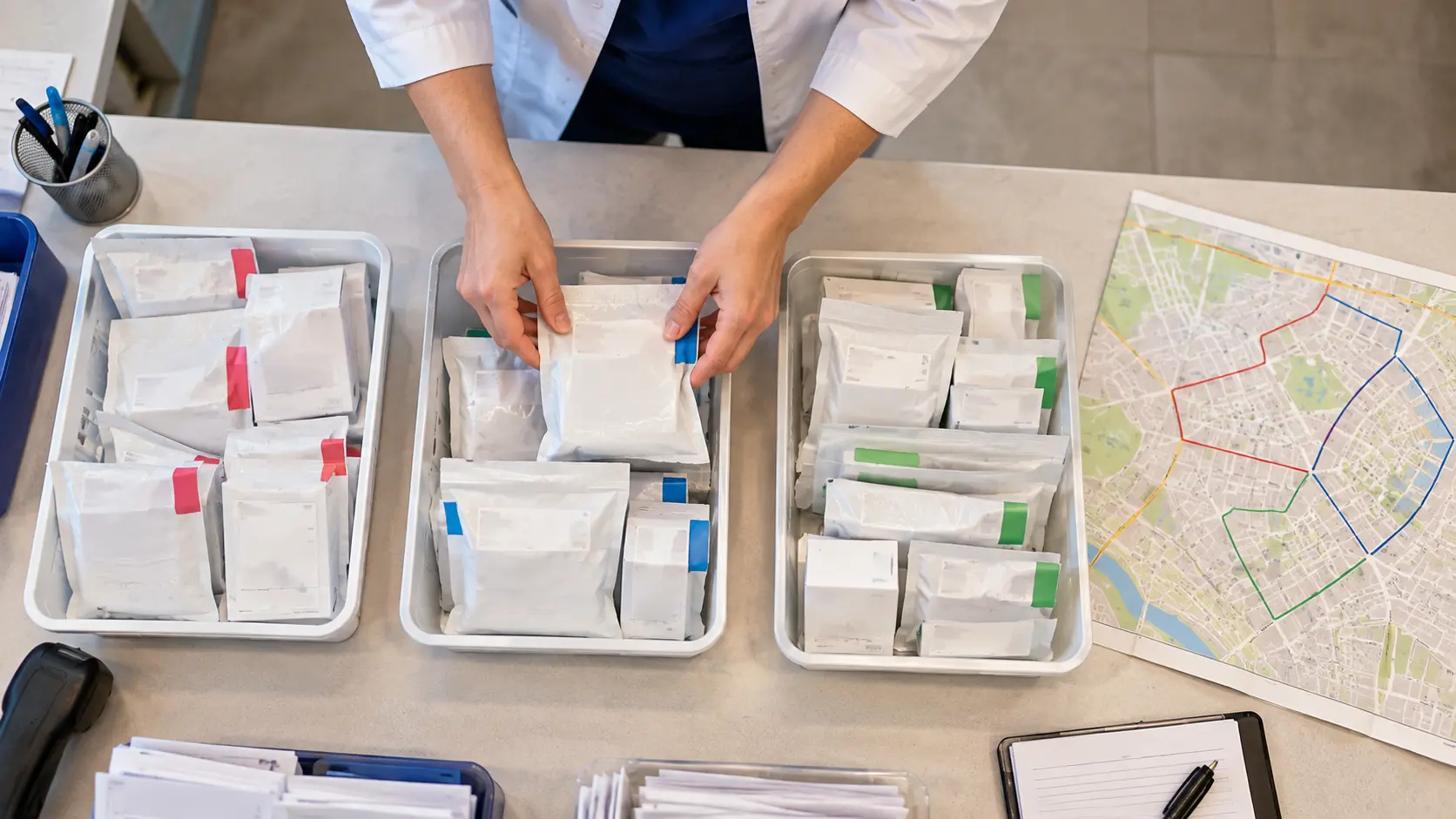
In pharmacy route planning, batching determines which deliveries leave together and which need separate runs.
Batching rules should account for:
- Geographic considerations: Batching of nearby locations that have a compatible route.
- Order availability: A partially completed order should never be batched with a departure run.
- Patient timing restrictions: Separation of stops that would cause timing problems.
- Consistent run times: Morning and afternoon runs could prove useful if there is a predictable pattern of pharmacy demand.
- Special urgency cases: An urgent order should be dealt with separately if including it would threaten the commitments made in the current run.
- Transportation needs: Orders should not be combined if the handling and transportation needs differ.
The research by the University of Twente in pharmaceutical last-mile logistics and medication synchronization considers all four elements (batching, delivery modes, staffing, temperature considerations) together. It reflects the idea that routing has to do with more than the distance alone. It does not suggest an optimal batch size for independent U.S. pharmacies.
Optimize Stops and Assign Drivers
Route planning specifies which stops to make and which driver will do the work. Pharmacy delivery route optimization compares stop sequences against driving time, delivery windows, and other route constraints. The optimized stop sequence may prove effective only if it fits the reality of what is deliverable.
For each planned run:
- Ensure the readiness list of orders is up-to-date along with necessary delivery intervals.
- Remove stops that cannot be combined due to incompatible delivery periods or transportation modes.
- Create routes that suit the driver’s schedule and vehicle size.
- Organize the stops taking into account driving time, service time, and delivery interval.
- Assign a route to a particular driver and synchronize packages at the handoff.
- Look into new additions and failed attempts rather than sticking to an initial plan all day long.
Think about the route that seems more economical but makes the driver arrive at a patient before the scheduled time. Rx4Route covers route planning, driver assignment, and delivery management via GPS in their website description. Use them to organize your workflow, not to replace the task of verifying the readiness of packages.
Verify Deliveries and Notify Patients

A pharmacy’s responsibilities do not end at the point where the last stop is marked on the map. The types of deliveries that the pharmacy makes and its internal policies will dictate what kinds of useful documentation can be kept for each delivery, including:
- QR scan and package identifier matching the correct order.
- Recipient signature or photograph, if applicable.
- Completion timestamp and delivery status.
- Reason for the failure and follow-up actions taken.
- Payment or copay collected, if required.
- Delivery notifications to patients regarding dispatch, arrival, or exception.
The Rx4Route system can scan QR codes, capture electronic signatures, take photographs, track deliveries, and send automatic notifications. However, a delivery notification should never include superfluous medication details simply because the notification template has room for additional information. The HHS guidelines for the HIPAA minimum necessary standard explain how covered entities must limit certain uses and disclosures of protected health information, with exceptions for disclosures to, and requests from, a healthcare provider for treatment.
Best Setup for Multi-Location Pharmacy Operations
Quick Answer: A multi-branch pharmacy delivery system works best when each delivery is always tied to the parent branch, and managers can see the system's overall status and capacity. Pick one of three methods of delivery depending on whether you want to organize deliveries on a branch level or coordinate them centrally. Sharing of drivers must be based on availability and demand.
In multi-location pharmacy management, routing raises two separate questions: “Where does the order need to be fulfilled?” and “Who will be responsible for the delivery of the order?” An inefficient route may increase costs associated with delivering a package from another branch.
A properly designed multi-location system will maintain the integrity of the starting pharmacy.
| Management factor | Branch-based routing | Centralized dispatch | Hybrid model | How to choose |
|---|---|---|---|---|
| Order queue | Separate per location | Common oversight with branch identification | Branch queues plus network view | Preserve order ownership in every model |
| Pickup coordination | Branch staff | Central team coordinates branches | Branch confirms readiness; central team plans | Favor local confirmation when preparation varies |
| Drivers | Commonly dedicated by branch | May be coordinated across branches | Dedicated core with conditional sharing | Compare pickup detours and service windows |
| Route changes | Local dispatcher | Central dispatcher | Defined split of authority | Specify who approves urgent changes |
| Exceptions | Local resolution | Centrally monitored | Locally handled, centrally visible | Avoid unresolved handoffs |
| Reporting | Per-branch | Network-wide | Both | Use comparable KPI definitions |
Keep Pharmacy Orders Organized by Location
In multi-location pharmacy management, every order must retain its branch identity even when staff views deliveries from several locations together. A good order record would include:
- The branch from which it comes and where it is to be picked up.
- The order number according to the particular branch's system.
- Its preparation and dispatch status (hold or otherwise).
- The driver and the route number allocated.
- The delivery window and any special handling instructions.
- Whether or not it has been successfully delivered.
Consider a scenario in which a driver picks up orders from Branch A but receives an order that actually came from Branch B. The system or dispatcher should ensure that the difference is made apparent; the order will appear to have been fulfilled while physically lying where it was picked up.
A big-picture approach may make order supervision easier overall without diluting branch responsibility.
Combine Central Visibility With Branch-Level Control

It does not have to be the case that all decisions will be made at one main office. Each location can still handle its own orders, while managers use the dashboard to monitor driver locations, late deliveries, and issues that need to be solved.
Central dispatch may help when many pharmacies share the same drivers or need assistance distributing delivery workloads. Local personnel still play a critical role because they know when prescriptions are ready for pickup and can resolve issues before the driver arrives.
The Rx4Route program can help manage multi-location deliveries and ensure all pharmacy teams can monitor deliveries across locations. To ensure that everything works effectively, every team member should understand his/her responsibilities. Pharmacy personnel confirm that the order is ready; dispatch assigns a route; delivery issues are resolved by the right people.
Choose Dedicated or Shared Delivery Drivers
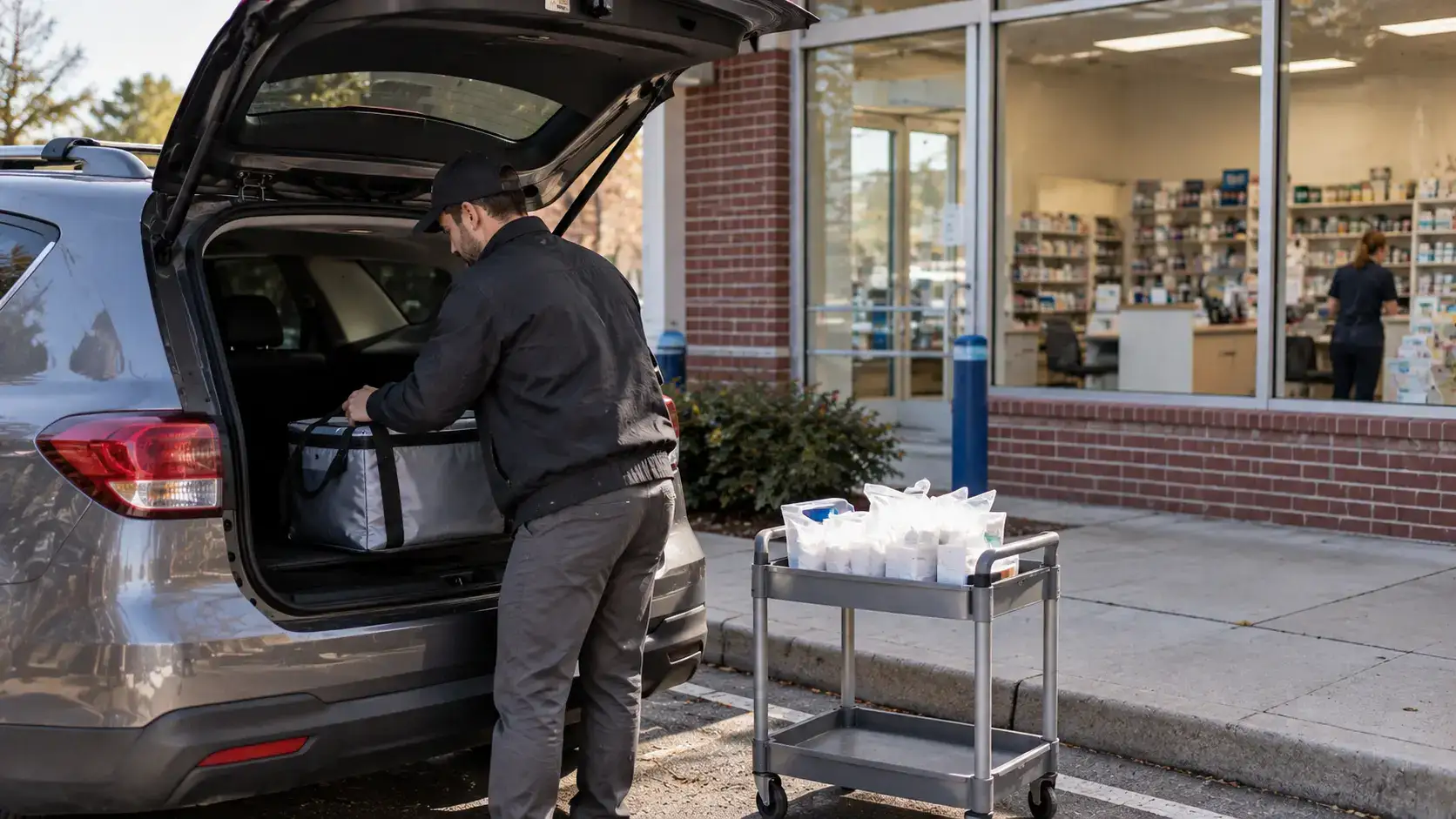
Whether to use dedicated or shared drivers in a pharmacy network largely depends on delivery volume and location proximity. Dedicated drivers normally know the pick-up procedures at the pharmacy and delivery zones.
Before making a choice, the following factors need to be compared:
- Delivery zones: It is important to check the overlapping routes and the distance drivers have to drive between branches.
- Driver workload: The number of deliveries done by drivers, busy times, and waiting times need to be assessed.
- Preparedness of orders: Ensure that all orders are ready before drivers arrive.
- Driver allocation: Determine who is responsible for routing and tracking orders at pharmacies.
- Delivery efficiency: On-time deliveries, completed stops, and distance traveled.
Consider dedicated drivers if pharmacies serve different zones or have consistent delivery volumes. Shared drivers can be considered if pharmacies are located close and have varying levels of deliveries.
In some cases, a combination of the two strategies might work well. Pharmacies can keep dedicated drivers for routine deliveries and share drivers during busy times or when another branch requires help.
Standardize Reporting Across Pharmacy Branches
Consistent multi-location pharmacy management depends on branches using the same definition of a completed delivery. Define ahead of time what a completed delivery is, what an attempt is, and how re-attempts will look in your reports. Then use the same definitions throughout the network.
Key indicators include:
- Completed deliveries: Deliveries considered completed for the chosen period.
- Percentage of on-time delivery: Number of completed deliveries within the delivery window divided by the number of deliveries with an applicable delivery window.
- Delivery failure percentage: Unsuccessful delivery attempts, using a consistent denominator.
- Miles per completed delivery: Miles driven for routes divided by completed deliveries.
- Driver utilization: Time spent delivering divided by the shift time available.
- Number of missing proof-of-delivery documents: Completed deliveries without required documentation.
- Resolution time for exceptions: Time from discovering a failed/doubted delivery to the resolution.
For pharmaceutical networks using medical couriers, Rx4Route also provides insight into courier management and multi-branch operations.
Pharmacy Routing Examples by Operation Type
Quick Answer: Generally, a lone pharmacy with limited territory will have only one controlled dispatch queue. Multiple branches with overlapping territories may need coordination when making assignments, and those delivering LTC and DME on a continual basis will also need batching. This provides an example of selecting among systems rather than mandating a single system.
These represent operating examples and do not describe experiences of individual Rx4Route customers. They show how pharmacy geography, preparation processes, and delivery methods influence optimal route selection. In any of these cases, it is assumed that the order data is accurate and that the pharmacy has sufficient workforce and drivers available to complete the proposed plan.
A local delivery run is not as complex as coordinating deliveries from a network of multiple pick-up points. Similarly, delivering packages to facilities may differ from delivering the same number of packages to residences.
One Independent Pharmacy With Local Deliveries
Consider a neighborhood pharmacy delivering orders in a known area. The pharmacy prepares orders during the course of the day, and these are picked up by a driver who will deliver them. Some patients might require certain deliveries or other requirements that should be observed by the drivers.
For independent pharmacy delivery, the best setup here is single-store routing with scheduled delivery batches. All the orders that are ready are added to the delivery queue. Before making any deliveries, the employees at the pharmacy confirm the delivery address and instructions before setting the stop locations for similar locations and delivery schedules. One team member is responsible for organizing the delivery schedule.
During the delivery, the pharmacy can monitor the progress of delivery and also respond to any missed deliveries. If the orders are prepared late most of the time, you can adjust the delivery schedule in order to make it work out.
Use this delivery setup if your pharmacy has one pickup point and it services an identifiable area and you can organize the driver assignments locally.
Several Pharmacies With Overlapping Delivery Areas
Example scenario: a chain of pharmacies operates branches in nearby areas. While each branch produces its orders, some patient addresses lie within overlapping delivery zones. One branch has a busy afternoon schedule, while the other has an early driver departure time. Pharmacy delivery route optimization can help compare coverage options without losing track of the branch responsible for each order.
Best solution: hybrid routing with centralized coordination in case of overlap. Each branch maintains a queue of orders marked with a clear identifier and checks package readiness. The dispatching system will be able to check order and driver availability in each branch. Assignments should be shared only when the pickup and delivery schedule is possible.
Nevertheless, local confirmation of the order pickup should be mandatory, despite centralization of the assignments, since the optimal route may include extra travel to pick up a package that is still not ready.
Use this solution in case of territory overlap, different workloads of each branch, and coordination capabilities in the network.
Pharmacy Network With LTC and DME Deliveries

Example Scenario: A Pharmacy Network delivers residential prescriptions and regular deliveries to LTCFs. Some deliveries include DME products. This organization needs to synchronize its scheduling and coordination of facility pick-up time, package/item ID, assignment of deliveries, and required documentation based on delivery type.
Preferred setup: Branch-identified orders and batched/optimized delivery type coordination. Schedule multiple facility stops based on delivery scheduling and order readiness. While multiple packages could be delivered through one facility stop, all orders/items from each of such stops should be accounted for separately. DME deliveries could require more detailed description of items, dates, recipients, and signatures per claim requirements.
The DME delivery management process described in Rx4Route includes PMS order synchronization, route optimization, delivery confirmation, and billing activities in regard to such deliveries. As an example of regulations governing DME delivery claims to Medicare patients, CMS documentation guidance should be considered. However, the requirements specific to Medicare billing of DMEPOS should not be considered applicable to ordinary prescription deliveries as well.
Choose this setup when a Pharmacy Network is delivering to LTCFs regularly or different delivery types require specific handoff procedures.
Common Route Planning Mistakes to Avoid
Quick Answer: Some of the most serious errors occur either prior to or following optimization and involve such things as delivering partially completed orders, not taking into consideration the time window for delivering to patients, combining orders across various branches, failing to record exceptions, and assuming that completion of a drive means all the orders have been completed.
If the system marks a package as ready while it's still being prepared, even the best stop sequencing will waste travel or waiting time. If the pickup location for the order is not assigned properly, then mileage calculations may become irrelevant. If the driver arrives at the address but can't deliver the package, the pharmacy should have an exception process in place, not a delivered status.
When analyzing a poor delivery operation, differentiate between the planning mistake and the operational issue. Pharmacy delivery route optimization addresses stop sequencing, while branch cooperation, order preparation, and record reconciliation still need separate attention.
Optimizing Mileage While Ignoring Delivery Constraints
Shorter does not mean a more preferable pharmacy route. This route can arrive at a patient earlier than the appointed window, require too much of a driver’s time to perform all services, or require a trip to the pharmacy because some package was not ready to deliver.
Here are common mistakes that should be avoided:
- Routing prescriptions earlier than they are ready: Dividing the queue of dispatchable prescriptions from those that are still being processed.
- Neglecting handoff time: Providing enough time for signature, access instructions, etc.
- Combining conflicting delivery windows: Planning arrival intervals as real ones.
- Insertion of urgent prescriptions without new assessment: Checking if an insertion will cause delaying of the whole route.
- Overloading a single driver: Considering route time, returning time, and time left in a shift.
In spite of a slight rise in travel distance, the route will be better if it fits planned stops better and prevents missing handoffs. Routes should be evaluated by number of delivered prescriptions and quality of service, not travel distance alone.
Mixing Pharmacy Locations Without Clear Ownership
Common software does not imply that all orders will become anonymous and without branch affiliation. When combining delivery information across a pharmacy network, the key measure is ensuring ownership of all orders from generation to closure.
Some possible issues and solutions:
- Incorrect pickup point – store the branch and confirm the location of the physical pickup point before sending orders to the delivery person.
- Duplicate driver assignment – keep only one dispatch record of each order and handle reassignment.
- Undefined decision-making – define the title of the employee who is responsible for changing active orders' routes.
- Inconsistent cancellation – ensure that any cancellations will not affect the status of the route in the driver's application.
- Discontinued document – connect the completed delivery document with the originating order.
Consider a situation where the patient calls the branch and asks where his/her prescription is. Employees of the branch should not have to call different drivers or check different systems to answer the question. This is especially relevant if several pharmacies share the service area geographically.
Losing Delivery Records After a Route Is Completed
There was no recipient available, there was an incorrect address, or there was a lack of signature. Considering route completion the same as order completion can mask such issues until a patient complains or an attempt is made to use the record for further purposes.
The process of closeout should include the following steps:
- What deliveries were successfully made and what deliveries were attempted but could not be done.
- Whether the required signature, picture, timestamp, or anything else serves as proof and is connected to the specific order.
- Whether the action to notify a patient or reschedule the delivery is still pending.
- Whether the payment for the delivery was received by the pharmacy.
- Whether there are any delivery-type specific documents that need to be stored for future referencing.
The CMS documentation requirements for DMEPOS claims show why delivery evidence can matter for reasons beyond the driver's needs. Medicare documentation requirements vary by item and delivery method. It would be inappropriate to make assumptions that some picture or timestamp is sufficient for all requirements.
Expert Tips for Evaluating Route Planning Software
Quick Answer: Assess the optimization of pharmacy delivery routing software via an entire, realistic delivery process cycle. Verify that order synchronization, routing, assigning of drivers, real-time status updates, exception management, delivery logging, and reporting capabilities are present. If your pharmacy operates multiple locations, include branch-related functionality. An effective assessment will reveal what your personnel can do effectively with your pharmacy’s PMS system and orders.
Demos of pharmacy delivery route optimization software often emphasize the routes drawn on a map. In pharmacy deliveries, the key questions are about everything around the map: how orders come in, how package readiness is confirmed, how a driver finds the right package, and what happens when a delivery doesn't go through. A beautiful route that doesn't address those aspects may fail to solve the real problem of the pharmacy.
The fact that Rx4Route focuses on pharmacy delivery is based on practical knowledge. This is evident in the company's history: its founder, Erkin Sattarov, once worked as a delivery driver and faced challenges such as lost slips, wrong addresses, and poorly optimized routes. These are practical challenges that should be considered during evaluation. The following matrix is a practical tool for evaluating pharmacy software solutions, not a scoring system.
| Evaluation criterion | Single-store priority | Multi-location priority | What to test | Evidence of a workable setup |
|---|---|---|---|---|
| PMS order integration | Critical | Critical | Import, edits, cancellation, status return | Correct records without unnecessary manual re-entry |
| Route creation and batching | Critical | Critical | Delivery windows, stops, package readiness | Feasible runs using real order patterns |
| Driver dispatch | Critical | Critical | Assignment and reassignment | One current owner for each active stop |
| Tracking and exceptions | Critical | Critical | Late, failed, and changed deliveries | Staff can identify and resolve the issue |
| Proof of delivery | Critical | Critical | Evidence captured for each delivery type | Records attached to correct orders |
| Branch identification | Less relevant for one store | Critical | Pickup point and originating location | No cross-branch confusion |
| Network-wide reporting | Secondary | Critical | Compare branches with common definitions | Reliable branch and network views |
| Patient notifications | Important when offered | Important when offered | Timing, wording, preferences | Appropriate, predictable messages |
Evaluate the Full Delivery Workflow
Start with the non-negotiable operations in the pharmacy. An application that offers multiple dashboard options but fails to share the necessary data with the existing PMS system can create more tasks rather than eliminate them. For independent pharmacy delivery, meaningful route automation does not require the branch-control features built for larger networks.
A proper evaluation will help you distinguish between the necessary features and nice-to-have features:
- Critical for all pharmacies: Order processing accuracy, route planning, driver scheduling, delivery management, exception management, and delivery confirmation.
- Critical for networks: Pharmacy identification, location transparency, report consistency, and explicit reassignment rules.
- Situationally useful: Billing automation, copay automation, LTC grouping, DME processes, and special messaging procedures.
- Useful if operations necessitate: Customization of dashboard options or creation of unnecessary reports.
The demonstration must include an example of an attempted failure and rescheduling of the delivery.
Test Routes Using Actual Pharmacy Delivery Patterns
Before adopting pharmacy delivery route optimization software, test the proposed setup against actual orders, delivery windows, and driver availability.
The following steps can be applied to compare the alternatives:
- Select representative delivery days. They should include regular days, peak delivery days, and deliveries with time limitations.
- Create delivery data. This can be done by using de-identified data or a secure test environment.
- Analyze current efficiency. Note delivery times, number of stops performed, mileage traveled, and number of unsuccessful deliveries.
- Test alternative routing setups. Apply available routing setups, including branch-based, centralized, or hybrid.
- Consider practical limitations. Driver availability, prescription completion time, delivery time windows, and pickup locations should be taken into account.
- Evaluate delivery challenges. Note route deviations, missed stops, and unforeseen delivery problems.
Compare the results to determine which alternative best fits your pharmacy. Any improvements will depend on the delivery specifics of your pharmacy.
The NIST HIPAA Security Rule resource guide may be helpful for protection of healthcare data.
Verify PMS Sync and Delivery Documentation
Ensure you verify the actual fields and events for transmission. You cannot measure connection success by whether one order is transmitted to the dispatching application.
Sample scenarios useful in testing are:
- Creation of a valid order delivery out of the PMS without duplications.
- Correcting an address before assigning the order.
- Cancellation of an order or reassigning to a different delivery period.
- Registering a failure without erroneously closing the order.
- Receiving the required completion information back into the pharmacy database.
- Maintaining all deliveries associated with the proper branch and order ID.
Review how the employees gain access to the patient's information as well as any third-party service provider that will use this information. According to HHS guidelines on business associates, the type of arrangement will help determine when such a partnership should be considered and what kind of security measures it encompasses. The nature of any business association depends on how the information is used and handled, not on whether it is described as delivery software or a courier service.
Compare Results Before Expanding to More Locations
For multi-location pharmacy management, test the first branch’s dispatch configuration before changing the process across the network. Comparing the process will help identify practical differences in preparation and delivery territory.
- Determine the baseline for the operation of the first branch that includes its busiest delivery times.
- Test the order and closeout process with the PMS configuration and drivers of the first branch.
- Determine common definitions of the delivered, attempted, delayed, and rescheduled orders.
- Check the identification and responsibilities of the branch prior to adding another branch to the management interface.
- Compare the needs of the second branch with the differences in the pickup time and delivery territory.
- Coordinate branches where appropriate and keep local control over processes where it is relevant.
Find out how driver onboarding works from the prospective provider of software, how the initial process is supported by the provider, and how they deal with dispatch exceptions.
Pharmacy Delivery Statistics and Benchmarks
Quick Answer: Industry statistics provide information about the size and variety of the operations of independent pharmacies, but they cannot determine the number of deliveries for a specific pharmacy. Rx4Route numbers show the scale of the system, but route performance depends on the order, driver, and delivery data for each pharmacy.
Prescription delivery does not mean prescription filling; package does not necessarily mean an additional stop; and a single facility stop might involve multiple prescriptions. Market statistics would help provide background information; firm descriptions would help explain their service coverage.
| Measure | Reported value or practical definition | Source and period | What it means for planning | Important limitation |
|---|---|---|---|---|
| Independent community pharmacy locations | Estimated 18,988 | NCPA 2026 Digest | Independent pharmacies remain a substantial operating segment | Not a count of pharmacies providing home delivery |
| Average prescriptions per independent store | 65,795 annually | NCPA, 2025 data published in 2026 | Shows dispensing scale across the market | Prescriptions are not delivery orders |
| Pharmacies using Rx4Route | More than 1,500 | Rx4Route website, reporting period unspecified | Indicates stated platform adoption | Company-reported, not an independent audit |
| Deliveries powered by Rx4Route | More than 70,000 per day | Rx4Route website, reporting period unspecified | Indicates stated platform activity | Does not establish outcomes for any one pharmacy |
| On-time delivery rate | Deliveries within a defined window / eligible deliveries | Pharmacy's own operations | Tests service reliability | Requires consistent promised-window data |
| Miles per completed delivery | Recorded route miles / completed deliveries | Pharmacy's own operations | Compares route efficiency | Should be read alongside on-time results |
| Proof-of-delivery completeness | Orders with required evidence/orders requiring it | Pharmacy's own operations | Tests closeout quality | Documentation varies by delivery category |
Independent Pharmacy Market Statistics
The NCPA 2026 Digest published on October 4, 2026, projected 18,988 community pharmacies operating independently in the US market. It further noted 65,795 prescriptions per pharmacy in 2025 against 67,601 in 2024. The statistics pertain to the pharmacy market and not the percentage of prescriptions delivered to the residences of patients.
The 2026 Digest further created a retail-LTC mix category for primary pharmacy operations. It is operationally significant since pharmacies that cater to facilities can prepare, consolidate, and deliver medicines in a different way than pharmacies whose focus is to deliver to residential addresses. The NCPA 2026 Digest has not assigned any standard volume of delivery routes to either of the categories mentioned above. The statistics provided by the Digest can be used by the pharmacies to get an idea of the market.
Rx4Route Platform Scale and Reported Metrics
According to Rx4Route’s website, more than 1,500 pharmacies rely on the platform, and it has enabled over 70,000 deliveries a day. These numbers indicate the platform's reach; however, no evidence is provided on how much better mileage, delivery time, or administrative work was accomplished.
When deciding whether this solution would be appropriate for a pharmacy client, the most valuable questions are practical: Can it integrate with the pharmacy PMS? Can it accommodate the branch layout planned? Is there any way for dispatchers to view real-time status of their own orders? Are there ways for the drivers to provide necessary proof of delivery?
Operational KPIs for Comparing Route Setups
Every pharmacy needs to create a mini scorecard and apply it consistently for all candidate solutions:
- Route Duration: Total duration of route journey from beginning until its last necessary stop, calculated as an average for all routes involved.
- Distance per Delivery: Route Distance / successful deliveries, including consistent tracking of pick-up travel.
- On-time Delivery Rate: Deliveries completed during the defined period / eligible completed deliveries.
- Delivery Failure Rate: Failed deliveries / total delivery attempts (distinguish between unique and repeated).
- Number of Completed Stops per Driver Shift: Successful delivery stops / driver shifts involved.
- Preparation Time for Dispatch: Staffing time to prepare orders, batch stops, dispatch routes.
- Completion of Proof of Delivery: Deliveries with full documentation/deliveries that require it.
In pharmacy route planning, no single KPI determines which setup works best. Analyze a few metrics over the same period of operations and look for outliers, not for an industry-wide benchmark.
How to Measure Real Pharmacy Route Planning Results
Quick Answer: Measure the impact of route-planning adjustments against a benchmark by comparing delivery volume, geographic distribution, available drivers, and delivery demand. Make sure that the improvements in order planning and traveling or dispatching are evaluated separately. Document exceptions and completion of paperwork along with miles driven and on-time delivery. Without such comparisons, it is difficult to conclude whether there was any improvement at all.
An example of a process improvement effort with documented outcomes can be found in pharmacy operations research, although it is not an example of an Rx4Route customer and cannot provide any data about this software's routing efficiency. For instance, a 2025 study at Changi General Hospital in Singapore examined the digitalization and automation of medicine preparation and dispatch. It was found that the average time spent on the bagging and dispatching of medicine delivery orders was reduced from 2.7 minutes to 0.28 minutes. These researchers' findings show that the order-handling process can be measured accurately; however, they say nothing about mileage saved or routing outcomes.
When measuring your pharmacy's routing process, follow the same approach: specify the initial conditions, the change made, and the outcomes achieved under similar conditions.
Document the Original Routing Workflow
Before changing a spreadsheet, reworking dispatch, or consolidating branch routes, outline the current process in terms of operations. Document how orders get put into the queue, who signs off on the packages being ready, how the routes are created, and how successful or unsuccessful stops feed back into the pharmacy log.
Your baseline should track:
- The number of pharmacy sites and pick-up points.
- Dispatched deliveries, unique stops, and attempted retries.
- Drivers and their usual departure times.
- Deliveries’ geographic territories and delivery windows.
- Length and distance of each route, starting and stopping at the same points each time.
- The time used to prepare dispatch and reconcile logs.
- Documentation missing and the types of exceptions.
If you are seeing rapid growth from your pharmacy, document order volume daily and per branch so any subsequent growth will not be misinterpreted as poor routing. Ensure that any analysis records you compile do not contain confidential patient data.
Explain the Route Planning Changes
Provide as detailed a description of the change as the baseline provided. An independent pharmacy could implement PMS order synchronization, regular batch release times, and driver assignments via the digital route. A network may continue branch-based preparations and use either centralized information on eligible routes or a coordinated driver scheduling system among adjacent branches.
Order import is reported as an order processing change if it saves time spent typing the order manually. Stop sequencing, which saves travel time for delivering the same orders, is reported as a routing change. Electronic signatures improve documentation results.
For instance, a peer-reviewed study published in 2025 on medication delivery process automation examined changes in data entry, bagging, and dispatch rather than attributing all improvements to delivery routing.
Compare Results and Explain Their Limitations
After any changes, the KPI definitions used during the baseline should remain the same. Check whether average deliveries per day, geographical reach, number of people involved, or delivery windows have changed. If the process shows high variability, choose several comparable periods rather than basing the analysis on one positive day.
Evaluate the outcomes jointly:
- Routing: Has the distance or duration of routing decreased without compromising delivery windows?
- Planning: Has planning become more automated and does not involve many corrections?
- Patient Service: Has the number of missed windows and failed attempts changed?
- Documentation: Has a larger proportion of possible orders been successfully closed with all documentation?
- Coordination: Is there any benefit from shared planning in terms of reach of the network?
A pharmacy delivery route optimization change may improve mileage while increasing labor or delays elsewhere, so results should be reviewed together. When making decisions involving patient data and delivery operations, HHS recommendations on disclosing treatment, payment, and operations information can help formulate proper policy on using Protected Health Information.
Choosing the Best Pharmacy Route Planning Setup
Choosing the right pharmacy route planning system depends largely on your pharmacy's order management, driver management, and delivery organization.
In case you run an independent pharmacy, a simple system configuration that includes a single delivery queue, planned routes, and driver assignments is sufficient. If you manage pharmacy chains, then there might be a need for a higher degree of coordination between different pharmacies. This is especially true if your drivers deliver orders for several different pharmacies or if delivery areas across the pharmacy chain overlap.
To choose an optimal solution for your pharmacy, consider your daily delivery volume, delivery locations, driver schedules, etc. It's crucial to know how orders are transferred to drivers and how deliveries are recorded after they are completed. Trying out several routing solutions for your deliveries can be helpful.
If you need pharmacy delivery software with an integrated pharmacy management system, route optimization, and other features, you can use Rx4Route services.
Pharmacy Route Planning FAQs for Independent and Chain Pharmacies
How should urgent prescriptions be handled after routes begin?
Verify the readiness of the prescription and determine the maximum delivery time. The pharmacy delivery route optimization process will evaluate a special run versus allocating the prescription to a driver who already has other stops to make.
Can pharmacies combine employees and outside medical couriers?
Yes. Employees and outside couriers can follow the same process for assigning and completing orders. Rx4Route offers pharmacy delivery route optimization software with driver tracking. Confirm how contractors receive assignments and report completed deliveries.
What should happen to deliveries when a branch closes unexpectedly?
First, separate orders still at the branch from those already with drivers and identify anything requiring special handling. For multi-location pharmacy management, assign a team to contact affected patients and keep each order linked to its original branch.
When should a pharmacy add a second delivery run?
To determine if a second delivery run should be added for independent pharmacy delivery service, look at how orders that were prepared following the first run fail to deliver within patients' delivery times. Evaluate the additional time and miles spent by the driver in comparison with missed or delayed deliveries before making any changes.
How should apartment buildings affect estimated route times?
Deliveries to apartments can take longer because of parking, building access, elevator use, or even needing to contact the recipient. The pharmacy route planning needs to make an allowance for this.
How should pharmacies record an unsuccessful delivery attempt?
Pharmacies must document an unsuccessful delivery attempt separately from a successful delivery, detailing the reason, timing, and next steps. Rx4Route will help you monitor deliveries and provide evidence of delivery in the form of an e-signature. Unresolved cases should be recorded so that the staff can make arrangements for further actions.
Should pharmacies stop accepting new orders once a route starts?
Absolutely not. The fixed departure time ensures proper scheduling; however, exceptions may require adding another stop to the route. Specify who can approve this addition, how the driver will handle the extra delivery, and when it's appropriate to add another stop.
How can pharmacies prepare routes for weekends and holidays?
When planning your route, consider staff availability, preparation time, patients’ schedules, and your pharmacy's holiday hours. Define delivery hours and inform your customers about them.
How can a pharmacy track orders reassigned between drivers?
Maintain one assignment per order and keep a record of who collects the reassigned order. This task can be done using Rx4Route, which provides facilities to manage drivers and routes. In case a driver is assigned to multiple branches, make sure you know the originating pharmacy and the assignment details.
What should pharmacies do when patient instructions change mid-route?
Pharmacy staff will confirm if the new instructions are received and if the driver would be able to deliver in a safe manner within the specified time limit. New instructions should be provided through company dispatch procedures.
